
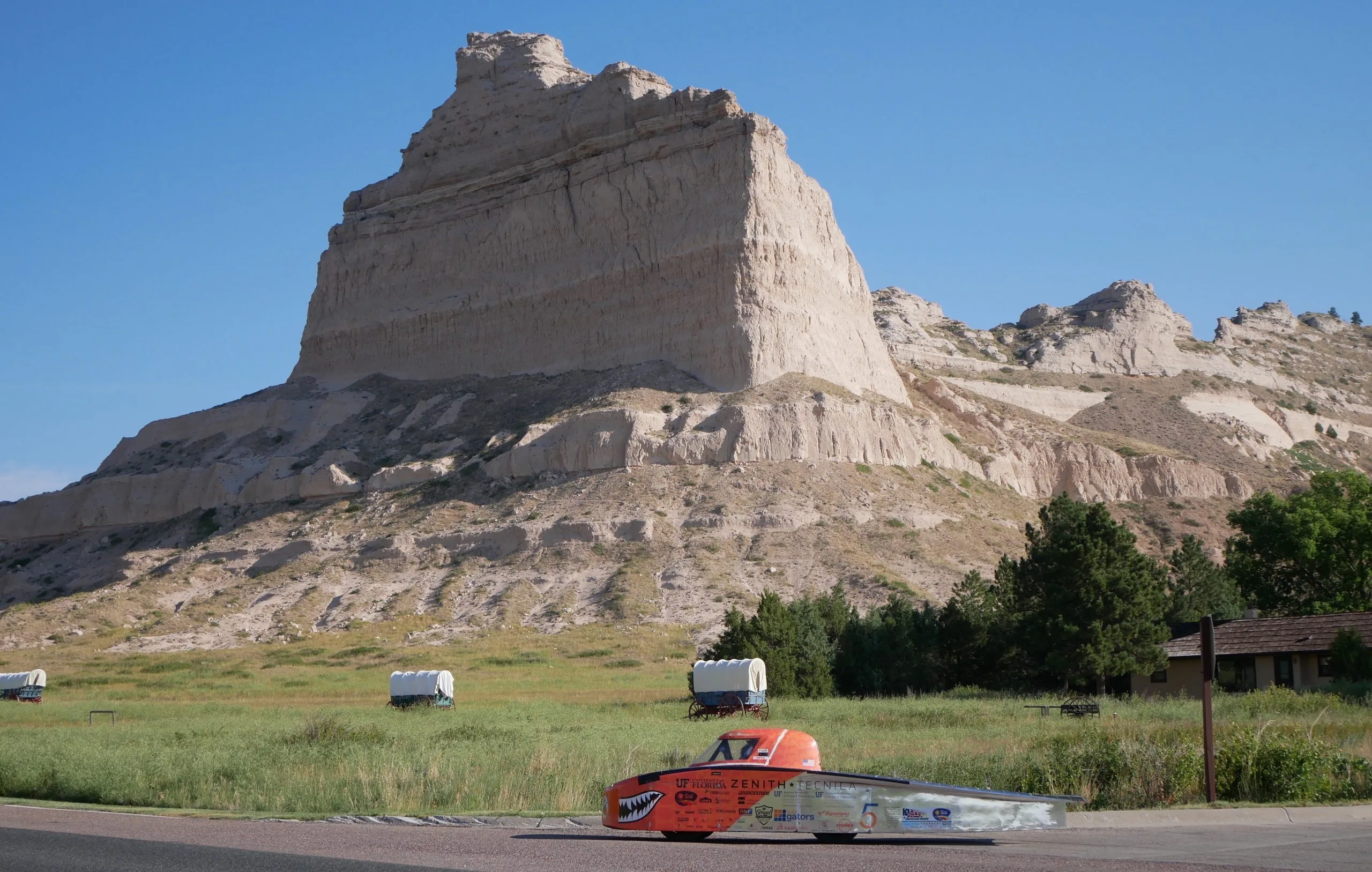
Following their national championship in 2023, UF student racing team Solar Gators placed fourth in the 2024 Formula Sun Grand Prix (FSGP) and qualified, for the first time in their history, to compete in the Electrek American Solar Challenge (ASC), a 1500+ mile rally-style race from Nashville, TN to Casper, WY. Supported by both the ECE Department and the Department of Mechanical and Aerospace Engineering, Solar Gators expertly navigated their third-generation car, Sun Rider, through exacting track conditions, inclement weather, and bad traffic, even overcoming an exploding battery management system as they competed against other university teams from across North America in two distinct races. The team’s hard work culminated in the chance to compete in the grueling ASC race, this year organized along seven National Historic Trails in partnership with the National Parks Service. Solar Gators ultimately were able to pilot Sun Rider into fifth place.
Formula Sun Grand Prix
The FSGP functions as the qualifier for the American Solar Challenge—teams completing more than the required 65 laps in one day (205 miles) are able to compete in the ASC. The 2024 edition of the FSGP competition featured 32 teams from universities across the US and Canada converging at NCM Motorsports Park in Bowling Green, Kentucky. The objective of the FSGP is simple—teams compete to complete as many laps as possible using nothing but solar energy to power their cars.
The UF team—comprised of students majoring in electrical, mechanical, and materials engineering—got off to a rough start. The morning of the competition, SunRider’s battery management system (a hugely important custom-designed circuit board) literally blew up when they went to start up the car. Ironically, the night before, the UF students had spent a number of hours assisting another team, actually integrating their own battery management system into their competitor’s car to ensure that they’d be ready to compete.
In the end, Solar Gators had just hours to modify a backup board before the competition was to begin. The problem? They didn’t have the right soldering equipment to do the repair. The solution? Student engineers used a hot plate to de-solder components that needed to come off and were able to make the necessary repairs in time.
Final results for the FSGP: Solar Gators came in fourth overall with 135 laps, good enough to qualify for the ASC.
American Solar Challenge

The Electrek American Solar Challenge is an 8-day 1550+ mile competition split into four stages. Solar cars departed from Nashville, TN and made their way to Casper, WY following seven National Historic Trails. The team quickly learned that driving conditions for the rally race, on open roads with traffic, were very different than those during the track event. Drivers’ endurance, as well as the car’s endurance, were all tested along the way.
Andres Duque, one of the drivers for the event, recalled going down a long hill on the route, finding himself traveling at 66mph—much faster than average speeds on the track—holding on for dear life. Drivers also had to deal with traffic on the route, sometimes having to pull off the road quickly to avoid causing traffic problems for the locals.
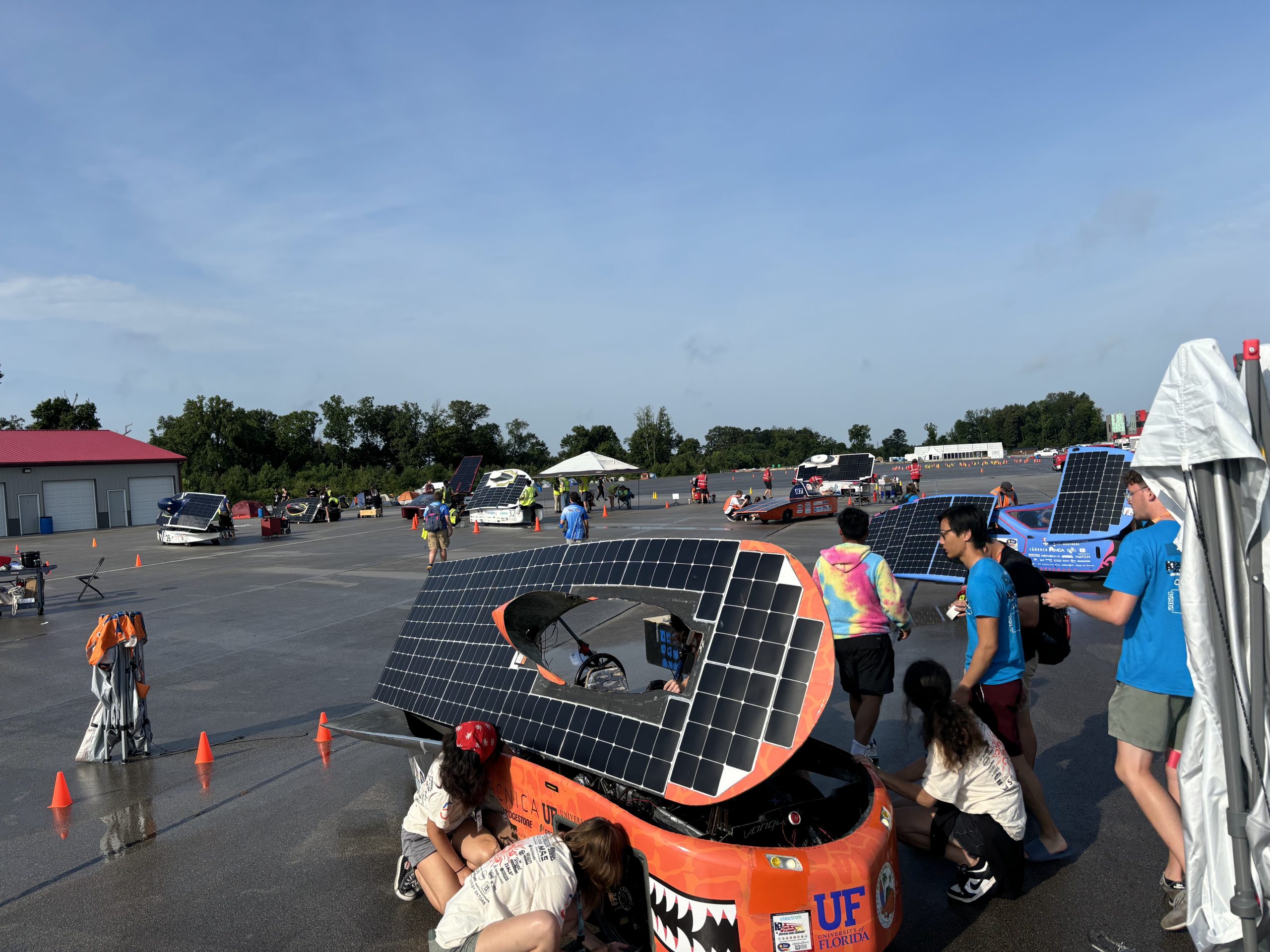
Careful planning was necessary to charge the car—pre-planned spots on the route were utilized for charging the cars. Obviously, battery optimization is the name of the game for this competition. Judicious use of regenerative braking and careful throttling made all the difference along the way.
Perhaps the universe noticed Solar Gators’ previous helpfulness at the FSGP and rewarded them. During the ASC, the team found that a portion of their solar array was nearly dead. Stopping at a nearby university, they were able to use their facilities to fabricate a portion of the array overnight and install it on the car for the next leg of the race.
In the end, the car performed admirably and the team was beyond pleased. Their designs, fabrication, and determination all paid off. Sun Rider completed a total of 1,465 miles in 60:27 hours at an average speed of 24.71 mph, enough to come in fifth place overall in the single-occupant vehicle category.
This was Sun Rider’s last hurrah—plans are afoot to build the next version of the design team’s car. It will be named Flare, and the team is already planning the modifications necessary to make the next-generation car even better.