
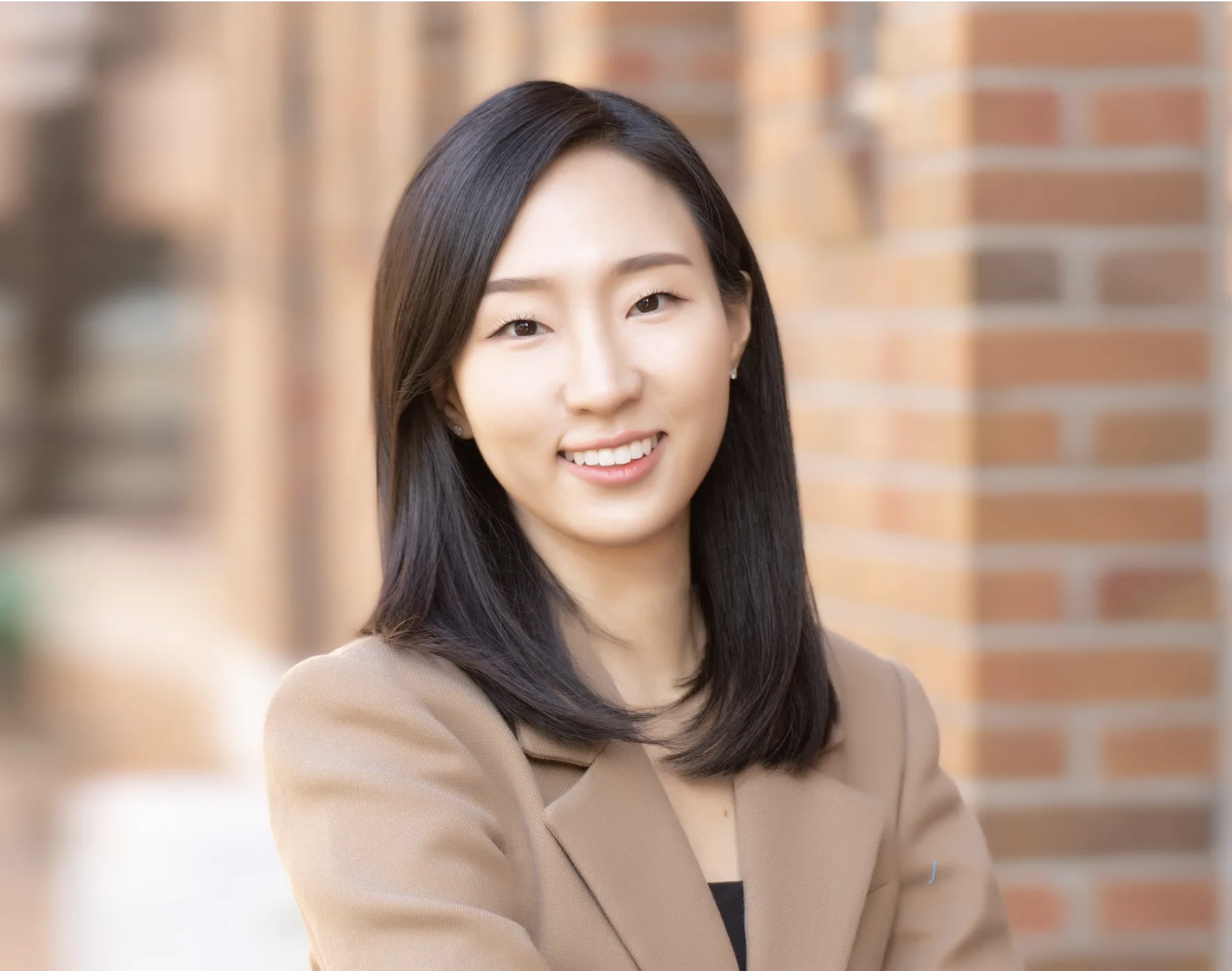
Laura Kim, Ph.D., has been awarded a DARPA Young Faculty Award in support of her project “Room-Temperature Strong Coupling in Intercalated 2D Plasmonic Systems.” The $500,000, two-year project seeks to unlock quantum phenomena that have traditionally remained exclusive to cryogenic temperatures, bringing them into room-temperature environments by using layered nanoscale materials that confine light with extreme precision.
Kim’s work builds on the rapidly growing promise of quantum light-based technologies, including quantum memory, secure communications, and ultra-precise sensing. These cutting-edge applications rely on accessing the deeply quantum nature of light, which has typically required elaborate experiments setups housed in highly controlled environments, placing most quantum technologies far from the realm of everyday use.
Kim’s DARPA-funded project aims to shift that paradigm by developing a chip-scale, solid-state platform that can operate under ambient conditions. A central focus of this project is achieving what is known as ‘strong coupling,’ a regime where light and matter interact coherently and rapidly so that they form entirely new light-matter quantum hybrid states. As systems enter this regime, they begin to exhibit progressively more quantum behaviors, including the precise generation and manipulation of single photons, photon-photon interactions, and nonlinear processes triggered by only a few photons. These capabilities are key to enabling ultrafast quantum gates, energy-efficient quantum operations, and even molecular-level control over chemical reactions. Kim’s project is positioned to realize all on a room-temperature platform, significantly lowering the barriers to practical deployment and marking a major milestone in the field.
Kim’s project pushes the boundaries by aiming to achieve robust and tunable strong coupling in engineered solid-state systems at room temperature, opening doors to new quantum phenomena and technologies once considered unattainable outside cryogenic environments.