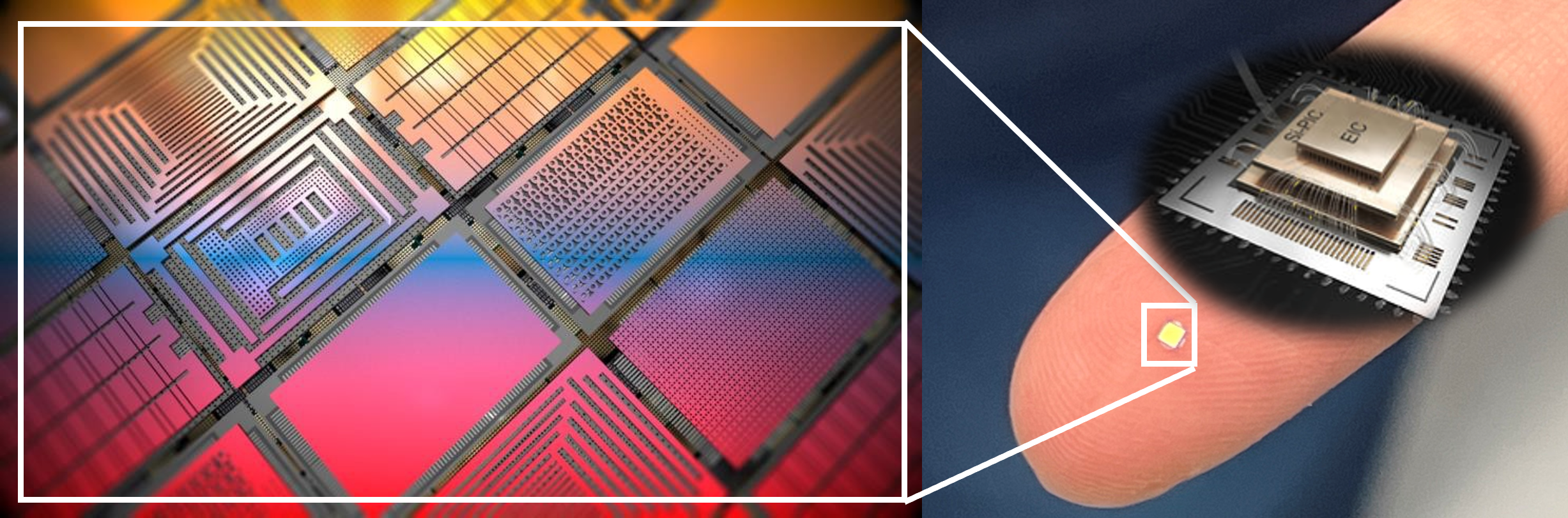
Hamed Dalir, PhD, and Elham Heidari, PhD, are collaborating with Relative Dynamics on a project recently funded by the National Aeronautics and Space Administration (NASA) which promises to dramatically expand the sensitivity of gravitational wave observatories such as LIGO and the planned space-based LISA mission, while also advancing applications in quantum magnetometry, fiber-optic gyroscopes, and biological imaging. Dalir is an associate professor in the Department of Electrical & Computer Engineering and is affiliated with the Florida Semiconductor Institute.
Also on the project is ECE post-doctoral researcher Abdolah Amirany, PhD. The Relative Dynamics team includes Chief Technology Officer Michael Krainak, PhD, and Vladimir Grigoryan, PhD. Krainak is the former Branch Head at NASA Goddard Space Flight Center with 15 years of service.
The project aims to produce quantum-enabled sensors that are capable of gathering data with levels of precision that were previously unattainable. The hope is that in combination with AI accelerators, the sensors will enable human-like decision-making in harsh environments where communication is significantly delayed (i.e. Mars) and where autonomous systems (rovers and the like) need to make judgements independently and instantaneously.
Squeezing Light

One of the fundamental principles of quantum mechanics is the uncertainty principle: one cannot determine two related properties, such as the position and momentum of a particle, with perfect accuracy at the same time. For light, this means its amplitude and phase always carry a certain amount of unavoidable “quantum noise.” In ordinary light, this noise is distributed equally. In a special state known as squeezed light, the noise in one property can be reduced below the normal limit, while the other property takes on more.
“What we’re hoping to do is by squeezing light, we’re shrinking scale and breaking limits. By moving quantum effects onto integrated systems on chip, we can enable scalable, low-loss hardware that meets NASA’s mission requirements.” — Hamed Dalir, PhD
The heart of the project is a high-speed photonic integrated analyzer capable of characterizing unconditionally entangled and noise-squeezed quantum states without the need for bulky, power-hungry optical phase-locked loops (OPLLs). Traditionally, an OPLL forces one laser to exactly match the frequency and phase of another, but this requires complex large-scale optics layouts unsuitable for space missions. Instead, the UF team is pioneering a phase-diversity architecture combined with real-time digital signal processing (DSP) to achieve stability on a chip.
“The biggest challenge is keeping optical losses extremely low,” explained Heidari. “We are addressing this by carefully refining waveguide design and fabrication, using advanced polishing and surface treatments to make the structures as efficient as possible.”

To ensure quantum advantages carry all the way from photon to decision, the project also pioneers a quantum-signal conditioning engine. This system turns delicate squeezed-light readouts into clean, high-rate features, using edge DSP to lock, calibrate, and denoise signals in real time. The result is data that is flight-grade and imminently reliable.
“Another key effort is translating quantum effects, which normally require bulky, free-space equipment to produce, into scalable, low-loss hardware and making it mission-ready,” added Abdolah Amirany, PhD, post-doctoral researcher in Dalir’s research group. “By uniting quantum photonics with AI accelerators, we are stepping into a future where machines can sense the universe in ways we’ve never imagined.”
This effort marks a significant step toward NASA’s long-term vision of deploying compact, quantum-enhanced sensing systems in space, while also paving the way for advances in navigation, communication, and biomedical imaging here on Earth.