
“Covalent 2D Magnets and Heterostructures”
Thursday, Oct. 23 at 11am
MALA 5050
Add to Calendar
Abstract
The recent realization of atomically thin van der Waals (vdW) magnets by exfoliation down to the monolayer limit has rekindled interest in 2D magnetism. However, most existing research has focused on exfoliated vdW systems, limiting materials choices. In this talk, I will introduce a class of lesser-explored materials known as covalent 2D magnets. These magnets emerge from the self-intercalation of native 3d transition metal atoms between layers of transition metal dichalcogenides, forming atomically thin, covalently bonded layered magnets denoted by the chemical formula M1+δX2. The degree of self-intercalation provides a unique mechanism to control 2D magnetism including exchange coupling, magnetic order, and spin texture. I will begin by discussing the synthesis of these materials, focusing on Cr2Te3, as well as the 2D magnet/2D semiconductor heterostructures. Subsequently, I will uncover an unconventional anomalous Hall effect (AHE) observed in such systems, which we attribute to Berry curvature contributions in momentum space associated with intercalated cations with canted magnetic moments. Time permits, I will also discuss our recent efforts to control the AHE using ionic gating.
Biography
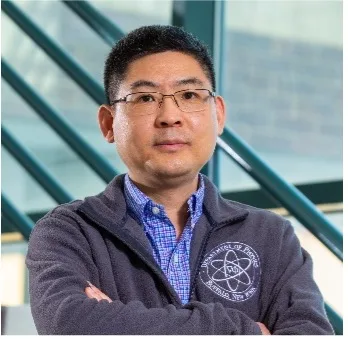
Hao Zeng, PhD, is the Moti Lal Rustgi Professor of Physics in the Department of Physics at the University at Buffalo (UB), State University of New York. He received his B.S. degree in physics from Nanjing University, China, in 1993, and his Ph.D. in physics from the University of Nebraska-Lincoln in 2001. From 2001 to 2004, he was a postdoctoral fellow at the IBM Thomas J. Watson Research Center. He joined UB as an assistant professor and was promoted to full professor in 2014.
Dr. Zeng is a fellow of the American Physical Society and a recipient of the Fulbright Scholarship and US NSF CAREER Award. He is the editor-in-Chief of Journal of Magnetism and Magnetic Materials. He has published 160 papers, which have been cited 25,000 times. His current research interests include nanoscale magnetism and spintronics, bio-applications of magnetic nanoparticles, and chalcogenide semiconductors.