
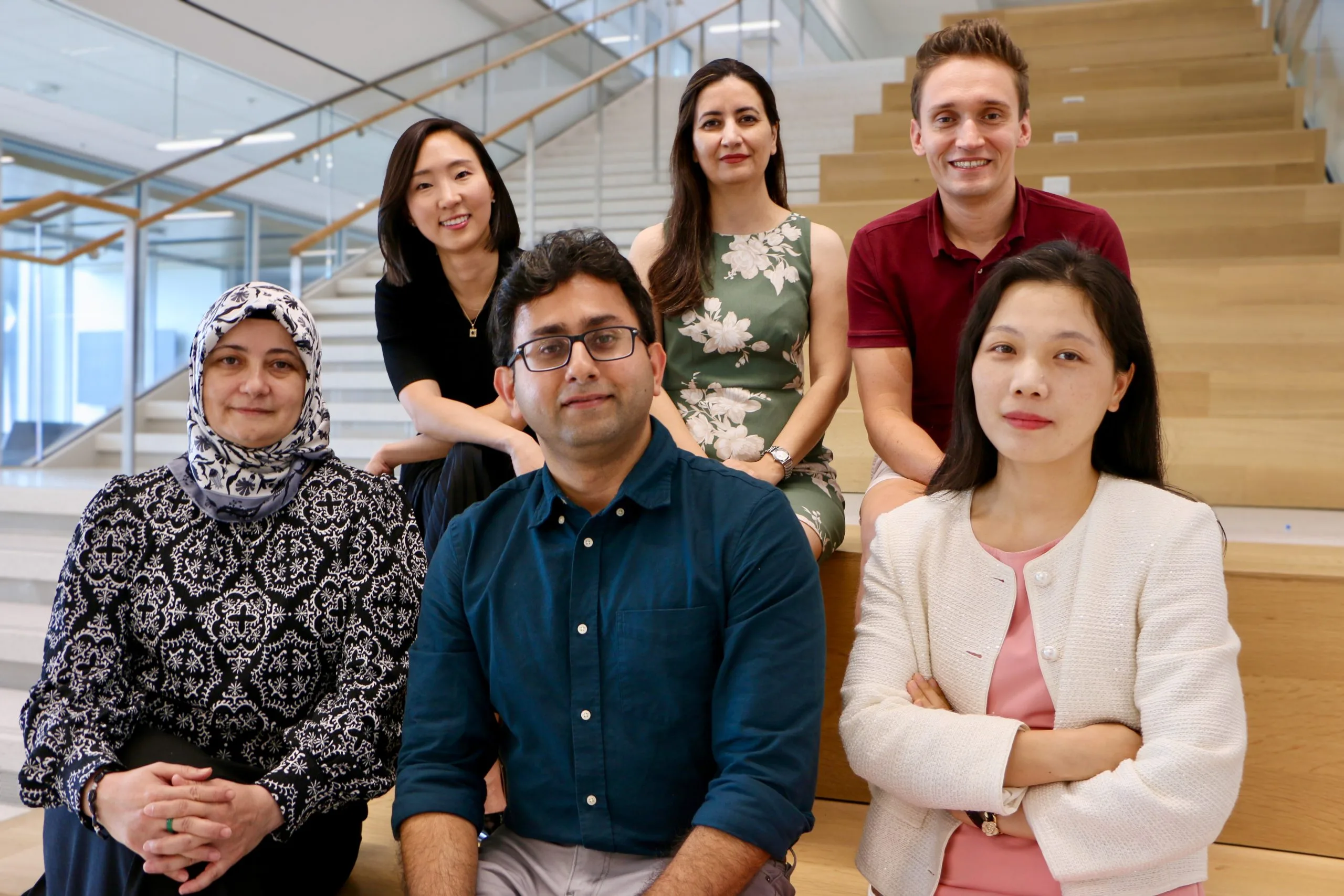
ECE’s early-career faculty members—typically assistant professors within 10 years of receiving their doctoral degrees—have had an unprecedented string of successes in the past academic year. No fewer than six early-career faculty members have earned young faculty awards from the National Science Foundation (NSF) and the Defense Advanced Research Projects Agency (DARPA) in 2025. Their success speaks to the dedication and innovation of these remarkable researchers.
The projects are summarized below.
Zoleikha Biron

Zoleikha Biron, PhD, is applying novel machine learning techniques to address challenges facing cyber-physical systems (CPS) in a project recently funded by the National Science Foundation. Her CAREER project, “Toward Resilient and Secure Cyber Physical Systems: Learn Fast from Experiences and Transfer the Knowledge,” aims to bring together analytical solutions and novel machine learning techniques to address interdisciplinary challenges of cyber-security and reliable operation of cyber physical systems (CPSs) with a case study on smart grids.
[ Learn more ]
Baibhab Chatterjee

Baibhab Chatterjee, PhD, has received a prestigious NSF CAREER Award, the agency’s highest honor for early-career faculty.
His funded project, “MED-IoB: Transforming Medical Electronics using Distributed Internet of Bodies (IoB) for Powering, Sensing, Communication and Synchronization,” seeks to revolutionize implantable and wearable medical electronics by enabling seamless data connectivity and power in a network of devices, leveraging the conductive property of the human body.
[ Learn More ]
Laura Kim

Laura Kim, PhD, has been awarded a DARPA Young Faculty Award in support of her project “Room-Temperature Strong Coupling in Intercalated 2D Plasmonic Systems.” The project seeks to unlock quantum phenomena that have traditionally remained exclusive to cryogenic temperatures, bringing them into room-temperature environments by using layered nanoscale materials that confine light with extreme precision.
Kim’s work builds on the rapidly growing promise of quantum light-based technologies, including quantum memory, secure communications, and ultra-precise sensing. These cutting-edge applications rely on accessing the deeply quantum nature of light, which has typically required elaborate experiments setups housed in highly controlled environments, placing most quantum technologies far from the realm of everyday use.
[ Learn More ]
Ivan Ruchkin

As work on improving cyber-physical systems (CPS) barrels ahead, Ivan Ruchkin, PhD, has some concerns. Loosely defined as mechanisms controlled and monitored by computer algorithms, CPS have some basic susceptibilities—rare events and unexpected circumstances can cause the system to react in unsafe or incorrect ways.
Thanks to funding from NSF—$600k over five years—Ruchkin aims to correct this. Ruchkin’s recently funded CAREER project, “Rigorous Assumption Engineering for Learning-Enabled Cyber-Physical Systems,” works toward his vision of assumption-aware CPS—ones that behave with an understanding of their own assumptions and limitations.
[ Learn More ]
Yingying Wu

Yingying Wu, PhD, has received a $546k NSF CAREER Award in support of her project, “Transforming Quantum Spintronics with Novel 2D Magnetic Transistors and Diodes.” This project will focus on creating new quantum hardware devices like magnetic transistors and diodes that use skyrmions.
These devices are expected to be more energy-efficient, scalable, and able to operate at elevated temperatures, helping overcome some of the biggest obstacles in quantum computing.
[ Learn More ]
Tuba Yavuz

With the ever-increasing number of cyber threats such as malware, it has become more critical to quickly and efficiently analyze the intended behavior of the software running the systems powering much of today’s tech-driven world.
ECE Associate Professor Tuba Yavuz is responding to these cybersecurity threats using a technique called ‘fuzzing.’ Her project, “Constraint-Guided Local Fuzzing of Binaries,” recently received $1M of funding as part of the highly prestigious Defense Advanced Research Projects Agency (DARPA) Young Faculty Award program.
[ Learn More ]