
Category: Research
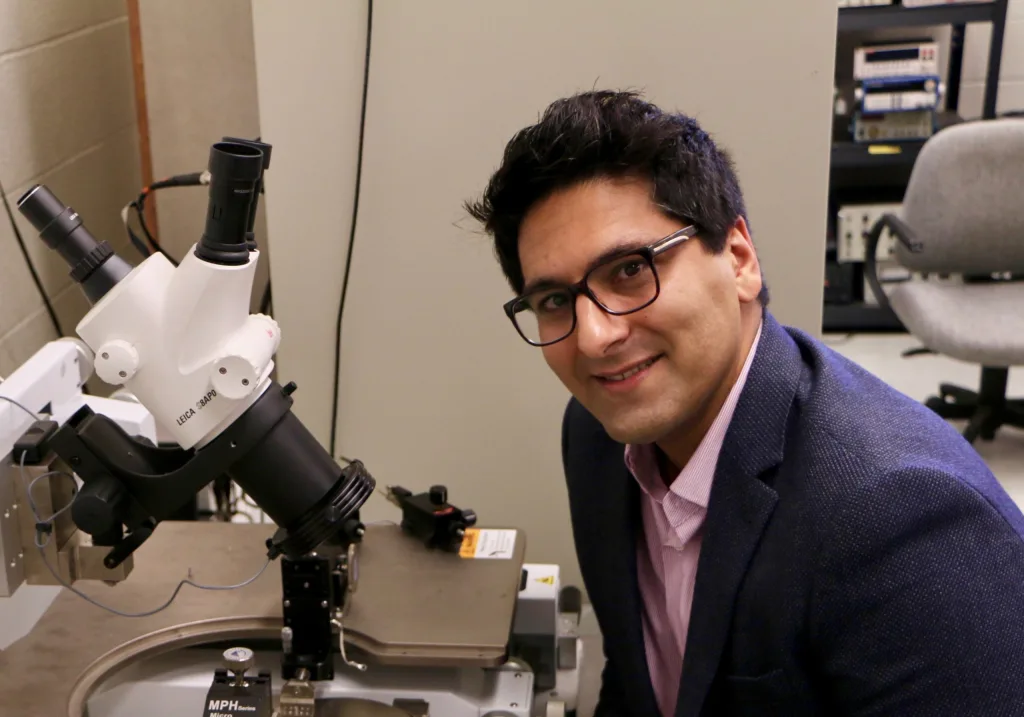
Tabrizian Receives Prestigious DARPA Director’s Fellowship Award
April 16, 2021Assistant Professor Roozbeh Tabrizian has been selected to receive a 2021 DARPA Director’s Fellowship, following his receipt of the 2019 DARPA Young Faculty Award (YFA).
Read more: Tabrizian Receives Prestigious DARPA Director’s Fellowship Award »Forte & Maghari Invent “Universal Testing Technique” to Detect Counterfeit Chips
April 13, 2021An article recently published in the Academic Times profiled exciting new technology patented by researchers at the Florida Institute for Cybersecurity (FICS) Research which promises a new way to detect recycled and counterfeit electronic parts. The technology created by ECE Associate Professor Domenic Forte and ECE Associate Professor Nima Maghari makes supply chains more secure, protects consumer safety and runs at almost zero cost.
Read more: Forte & Maghari Invent “Universal Testing Technique” to Detect Counterfeit Chips »
Yoon and UFTI Study Bus Bike Rack Usage
March 10, 2021ECE Professor Yong-Kyu Yoon and UF Transportation Institute (UFTI) Director Lily Elefteriadou were recently interviewed by WUFT News about a years-long study of bus bike rack usage on local RTS buses. Dr. Yoon and his students deployed sensors on the racks which enabled them to track activity over time.
Read more: Yoon and UFTI Study Bus Bike Rack Usage »Yoon & Mosaic Microsystems Collaborate to Develop Next-Generation Radar Array Tech
March 10, 2021YK Yoon and Mosaic Microsystems are collaborating on a project sponsored by the Air Force Research Lab (AFRL) to collaboratively develop ultra-low loss solutions for next-generation radar arrays.
Read more: Yoon & Mosaic Microsystems Collaborate to Develop Next-Generation Radar Array Tech »Tabrizian and Bhunia Develop Clandestine Wireless ID Tags
November 25, 2020In a new paper published in Nature Microsystems and Nanoengineering, a team led by Dr. Roozbeh Tabrizian and Dr. Swarup Bhunia has demonstrated a novel product-labeling approach based on resonant nano-electro-mechanical systems (NEMS).
Read more: Tabrizian and Bhunia Develop Clandestine Wireless ID Tags »Zare’s $1.2 Million Award Brings Machine Learning to Plant Root Science
November 18, 2020A team of researchers from ECE Florida and IFAS has received a $1.2M grant from the United States Department of Agriculture (USDA) that combines machine learning, hyperspectral cameras, and minirhizotron tubes to nondestructively study root systems of plants.
Read more: Zare’s $1.2 Million Award Brings Machine Learning to Plant Root Science »
Alina Zare Assists with Hunt for Better Biofuel
October 29, 2020Dr. Alina Zare and the Machine Sensing Lab are part of team working to engineer a more powerful biofuel—using switchgrass, a fast-growing perennial native to the U.S.
Read more: Alina Zare Assists with Hunt for Better Biofuel »FICS Research Expands Industry Partnerships, Workforce Development
October 23, 2020FICS Research is well-known and regarded as a global leader in hardware security and systems security research. While high-powered, high-dollar research is certainly one of the main thrusts of FICS Research’s activities, there is another that garners less recognition—workforce development.
Read more: FICS Research Expands Industry Partnerships, Workforce Development »Engineering Plays a Leading Role in Agriculture Practices of the Future
September 21, 2020Q&A with Dr. David Arnold and Dr. Alina Zare, working together on the recently created NSF ERC IoT4Ag Center
Read more: Engineering Plays a Leading Role in Agriculture Practices of the Future »Eisenstadt Introduces Smart Mosquito Cages to Effectively Test Insecticides
August 18, 2020Recent work by ECE Professor William Eisenstadt, supported by a grant from the Centers for Disease Control, seeks to equip the traditional ‘bioassay’ cages with networked sensors which are capable of delivering instantaneous data to handheld devices to ensure that the testing of mosquito control methods is more precise and more rigorous.
Read more: Eisenstadt Introduces Smart Mosquito Cages to Effectively Test Insecticides »