
Tag: 2025 Fall Newsletter

UF Engineering teams take top honors at Mission Autonomy Hackathon
November 25, 2025Two University of Florida teams earned top honors and a combined $35,000 in awards at the Mission Autonomy Hackathon, a national competition hosted by Amazon Web Services (AWS) and Vanderbilt University in Nashville.
Read more: UF Engineering teams take top honors at Mission Autonomy Hackathon »
Fall 2025 message from the chair
November 24, 2025Dear ECE students, staff, faculty and friends, I am thrilled to share ECE’s highlights from the fall semester.
Read more: Fall 2025 message from the chair »
Harley joins forces with 3 other universities to accelerate innovation in AI-augmented health systems
November 18, 2025Healthcare systems see significant promise in AI for improving care delivery and controlling costs, yet face significant barriers to safe and effective implementation, including concerns about AI accuracy, patient safety, and integration with health system workflows. Joel Harley, Ph.D., is working to overcome some of these barriers. Harley is set to co-direct the Accessible Healthcare through […]
Read more: Harley joins forces with 3 other universities to accelerate innovation in AI-augmented health systems »
UF student hackers enter ‘Plato’s Cave’ for first-place win
November 10, 2025A student team from the Florida Institute of National Security (FINS) took top honors late last month at Gator Hack, the University of Florida’s 2025 AI Days hackathon.
Read more: UF student hackers enter ‘Plato’s Cave’ for first-place win »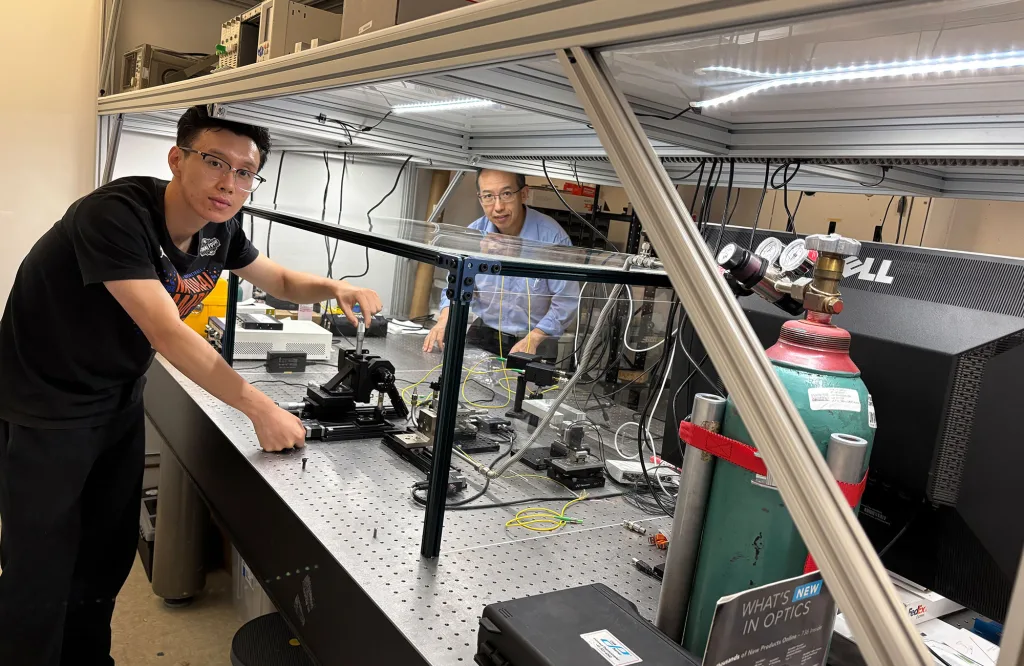
Turning up the light: harnessing the potential of silicon carbide in optomechanical devices
October 30, 2025Described in a new study published in Photonics Research and selected for inclusion in Spotlight on Optics, researchers at the University of Florida and Carnegie Mellon University (CMU) have built a chip-sized device that uses forces exerted by photons to “strum” a single-crystal 4H silicon carbide (SiC) microdisk, inducing it to vibrate at frequencies that can be detected with the right techniques and equipment.
Read more: Turning up the light: harnessing the potential of silicon carbide in optomechanical devices »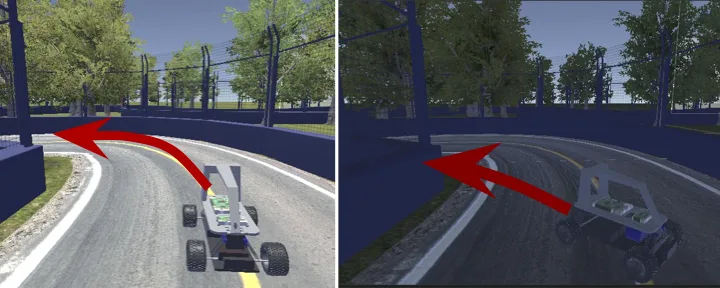
Ruchkin & Príncipe get visual
October 28, 2025Ivan Ruchkin, PhD, and José Príncipe, PhD, are collaborating on an NSF-funded project aiming to create an end-to-end methodology to model, analyze, quantify, detect, and adapt to changes in the visual environment of an autonomous cyber-physical system.
Read more: Ruchkin & Príncipe get visual »
New Power Electronics Lab Honors ECE Alumnus, Powers Teaching & Research
October 3, 2025Monolithic Power Systems, manufacturer of small, highly energy efficient, easy-to-use industrial power management solutions, formally dedicated a named lab space in Benton Hall on Thursday, Oct. 2. The newly renovated lab space is designed to strengthen the department’s research and teaching capabilities in the area of power electronics, while enhancing opportunities for collaboration.
Read more: New Power Electronics Lab Honors ECE Alumnus, Powers Teaching & Research »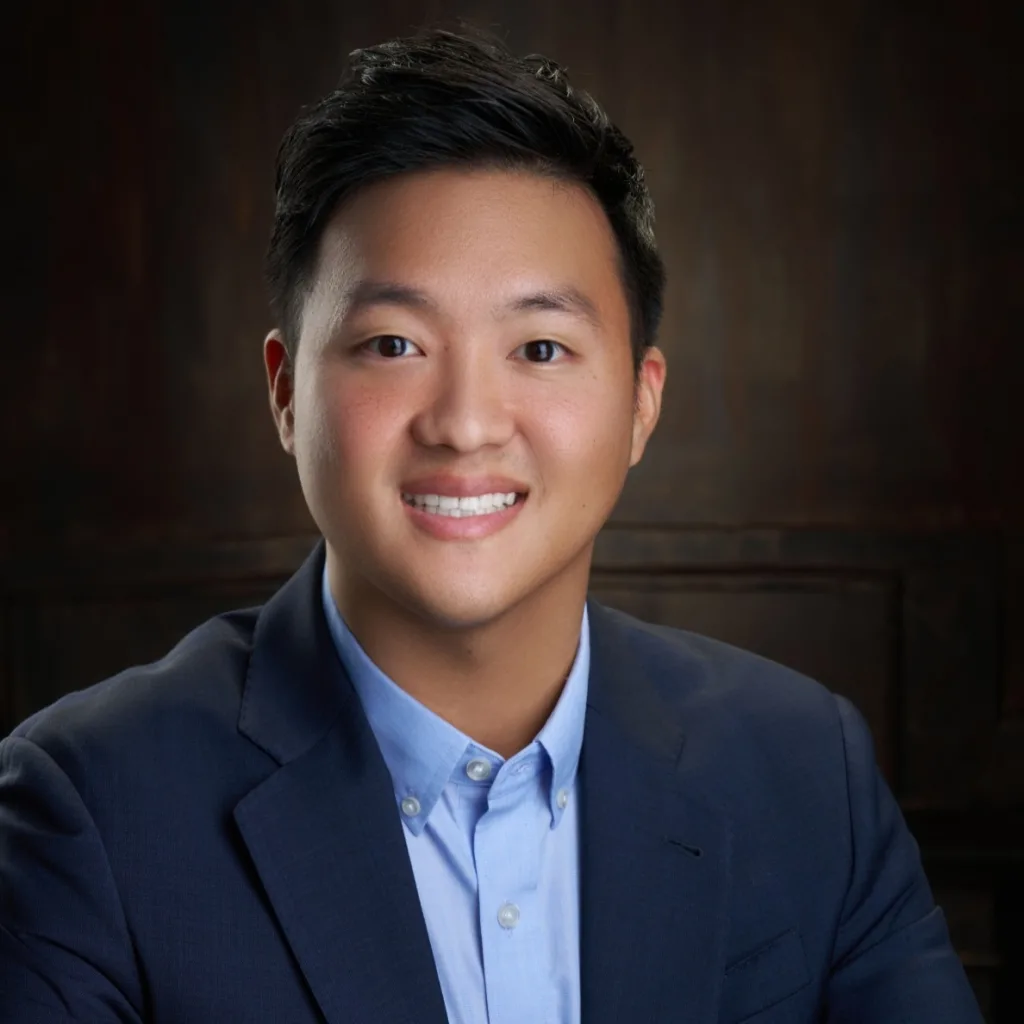
Kim and Anderson Secure DARPA Grant to Transform Chip Manufacturing Using Atom-to-Wafer Framework
October 3, 2025Dennis S. Kim, Ph.D., alongside co-PI Travis Anderson, Ph.D., from UF Chemical Engineering, have received a DARPA CRYSTAL grant to replace costly trial-and-error methods in wafer bonding with predictive modeling. The project tackles a critical manufacturing challenge: even advanced platforms like lithium niobate on insulator (LNOI) lack reliable models to predict optimal bonding conditions, limiting the scalable production of next-generation photonic, sensing, and electronic devices.
Read more: Kim and Anderson Secure DARPA Grant to Transform Chip Manufacturing Using Atom-to-Wafer Framework »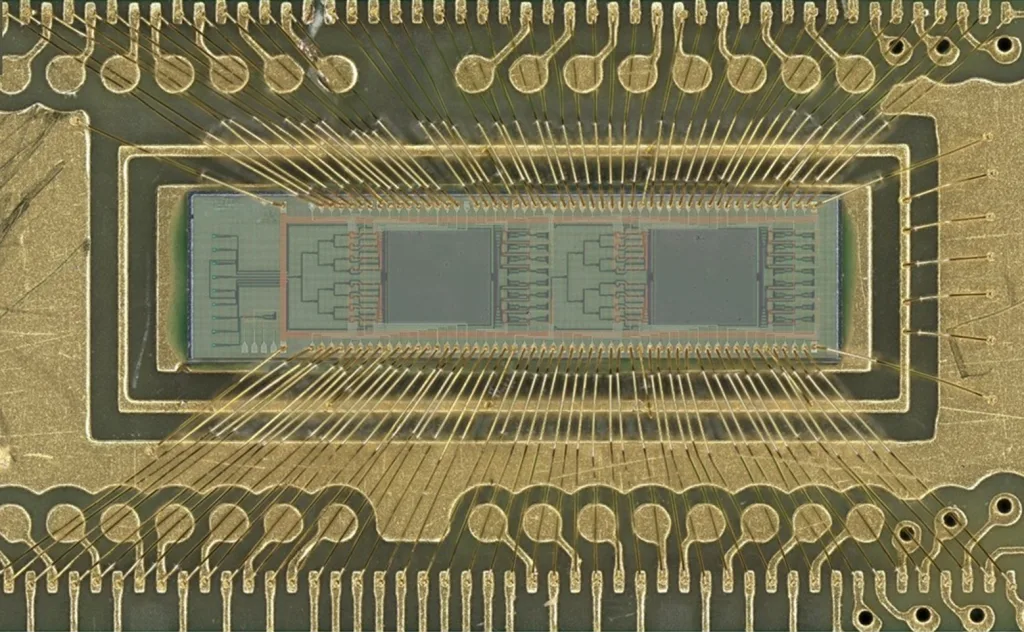
New light-based chip boosts power efficiency of AI tasks 100 fold
September 8, 2025A team of engineers has developed a new kind of computer chip that uses light instead of electricity to perform one of the most power-intensive parts of artificial intelligence — image recognition and similar pattern-finding tasks.
Using light dramatically cuts the power needed to perform these tasks, with efficiency 10 or even 100 times that of current chips performing the same calculations. Using this approach could help rein in the enormous demand for electricity that is straining power grids and enable higher performance AI models and systems.
Read more: New light-based chip boosts power efficiency of AI tasks 100 fold »
Gator Africa Promises to Bring Collaboration, Exchange with Sub-Saharan Universities
August 26, 2025A new initiative, led by Sachio Semmoto Chair of ECE Mark Tehranipoor and ECE Associate Chair for Academics Christophe Bobda, promises to connect University of Florida (UF) students and faculty with faculty and students from ECE departments and engineering colleges across Sub-Saharan Africa.
Read more: Gator Africa Promises to Bring Collaboration, Exchange with Sub-Saharan Universities »