
Category: Research

Kim and Anderson Secure DARPA Grant to Transform Chip Manufacturing Using Atom-to-Wafer Framework
October 3, 2025Dennis S. Kim, Ph.D., alongside co-PI Travis Anderson, Ph.D., from UF Chemical Engineering, have received a DARPA CRYSTAL grant to replace costly trial-and-error methods in wafer bonding with predictive modeling. The project tackles a critical manufacturing challenge: even advanced platforms like lithium niobate on insulator (LNOI) lack reliable models to predict optimal bonding conditions, limiting the scalable production of next-generation photonic, sensing, and electronic devices.
Read more: Kim and Anderson Secure DARPA Grant to Transform Chip Manufacturing Using Atom-to-Wafer Framework »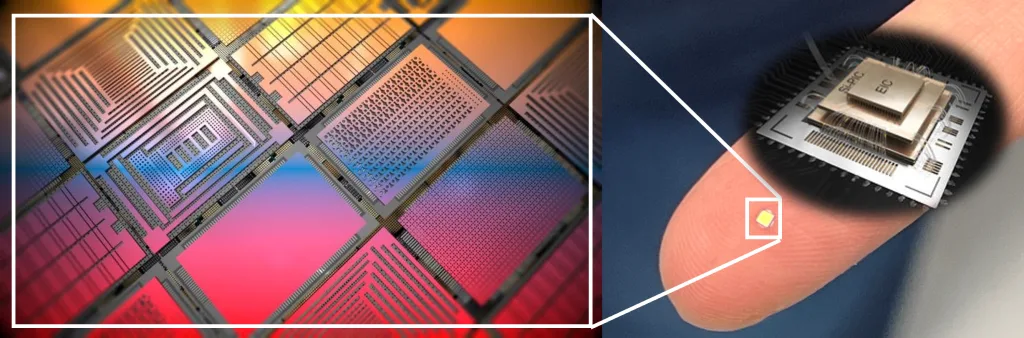
From Lab to Orbit: Unlocking Next-Gen Gravitational Detection with Quantum-Squeezed Photonic Integrated Circuit
September 25, 2025ECE researchers Hamed Dalir, PhD, and Elham Heidari, PhD, are collaborating with Relative Dynamics on a project recently funded by the National Aeronautics and Space Administration (NASA) which promises to expand the sensitivity of gravitational wave observatories such as LIGO and the planned space-based LISA mission, while also advancing applications in quantum magnetometry, fiber-optic gyroscopes, and biological imaging.
Read more: From Lab to Orbit: Unlocking Next-Gen Gravitational Detection with Quantum-Squeezed Photonic Integrated Circuit »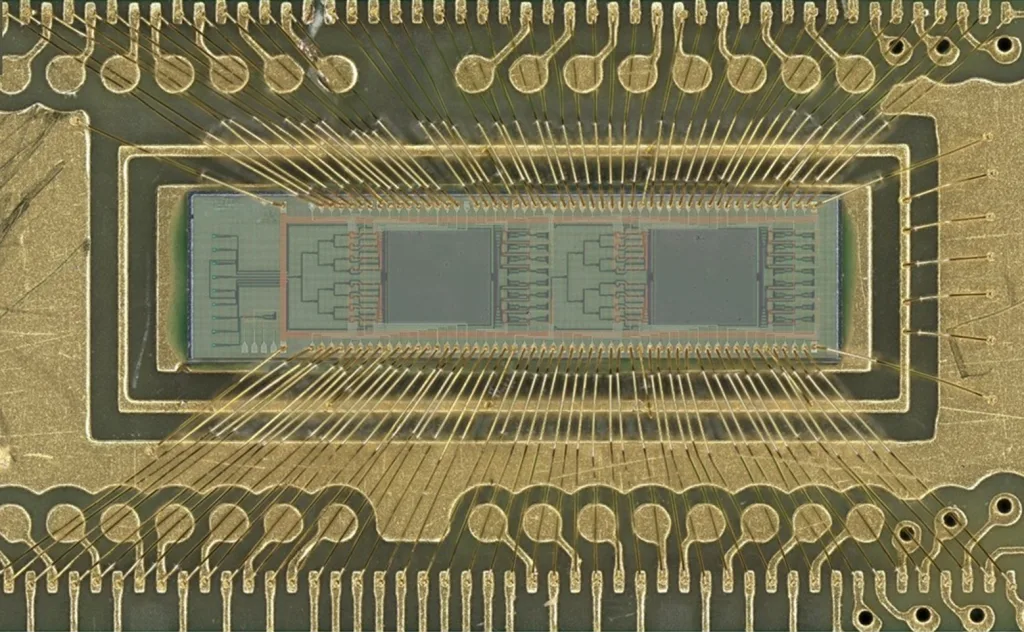
New light-based chip boosts power efficiency of AI tasks 100 fold
September 8, 2025A team of engineers has developed a new kind of computer chip that uses light instead of electricity to perform one of the most power-intensive parts of artificial intelligence — image recognition and similar pattern-finding tasks.
Using light dramatically cuts the power needed to perform these tasks, with efficiency 10 or even 100 times that of current chips performing the same calculations. Using this approach could help rein in the enormous demand for electricity that is straining power grids and enable higher performance AI models and systems.
Read more: New light-based chip boosts power efficiency of AI tasks 100 fold »
Ray Works to Validate Hardware-Software Interactions with New NSF-Funded Project
September 3, 2025Sandip Ray, Ph.D., has received $300k in funding from the National Science Foundation in support of his research in the area of post-silicon validation. The project, “SOCRATES: Post-Silicon Validation of Hardware-Software Interactions,” is a collaboration with researchers at the University of Illinois-Chicago.
Read more: Ray Works to Validate Hardware-Software Interactions with New NSF-Funded Project »
Biron’s NSF CAREER Project Helps Cyber-Physical Systems Learn Faster
September 3, 2025Zoleikha Biron, PhD, is applying novel machine learning techniques to address challenges facing cyber-physical systems (CPS) in a project recently funded by the National Science Foundation.
Read more: Biron’s NSF CAREER Project Helps Cyber-Physical Systems Learn Faster »
Gator Africa Promises to Bring Collaboration, Exchange with Sub-Saharan Universities
August 26, 2025A new initiative, led by Sachio Semmoto Chair of ECE Mark Tehranipoor and ECE Associate Chair for Academics Christophe Bobda, promises to connect University of Florida (UF) students and faculty with faculty and students from ECE departments and engineering colleges across Sub-Saharan Africa.
Read more: Gator Africa Promises to Bring Collaboration, Exchange with Sub-Saharan Universities »
Young Faculty Award Winners Power ECE’s Research Future
August 21, 2025ECE’s early-career faculty members have had an unprecedented string of successes in the past academic year. No fewer than six early-career faculty members have earned young faculty awards during 2025.
Read more: Young Faculty Award Winners Power ECE’s Research Future »
Yavuz Receives Prestigious DARPA Young Faculty Award
August 19, 2025Tuba Yavuz, PhD, is responding to cyberthreats using a technique called ‘fuzzing.’ Her project, “Constraint-Guided Local Fuzzing of Binaries,” recently received $1M of funding as part of the highly prestigious Defense Advanced Research Projects Agency (DARPA) Young Faculty Award program.
Read more: Yavuz Receives Prestigious DARPA Young Faculty Award »
Tech Meets Tide: UF RoboPI Lab Joins Forces for Marine Ecosystem Monitoring
August 12, 2025The RoboPI group at the University of Florida’s Department of Electrical and Computer Engineering, led by Md Jahidul Islam, PhD, recently joined forces with the Ocean Rescue Alliance International (ORAI) and the International SeaKeepers Society to advance marine robotics for ecosystem monitoring. The collaboration focused on testing fully autonomous survey and mapping technologies designed to better understand the growth and health of remote marine habitats.
Read more: Tech Meets Tide: UF RoboPI Lab Joins Forces for Marine Ecosystem Monitoring »Ruchkin Seeks Greater Confidence (in Cyber-physical Systems)
July 25, 2025Ivan Ruchkin, Ph.D., is not satisfied with how state-of-the-art cyber-physical systems deal with anomalies. A project recently funded by the National Science Foundation aims to fill in the gaps in current methodologies.
Read more: Ruchkin Seeks Greater Confidence (in Cyber-physical Systems) »